Oceans Beyond Earth
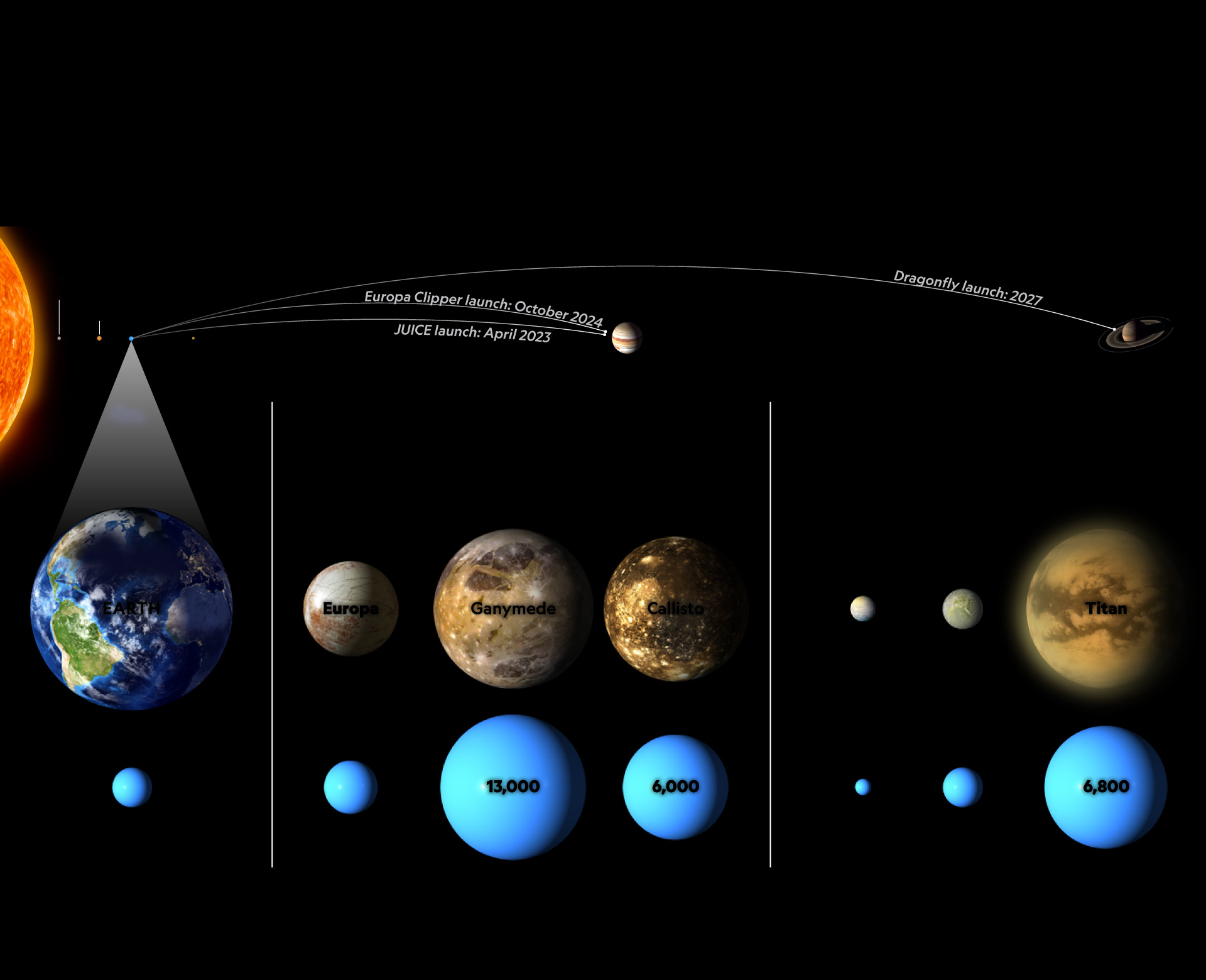
Liquid water—warmed indirectly by gravitational forces—exists on several of the solar system’s moons. Some may even contain exponentially more water than exists on Earth. While liquid water is suspected on one of Neptune’s moons, the moons of Jupiter and Saturn are closer and easier to visit. Spacecraft are slated to explore their watery worlds over the next two decades.
SUN
Mercury
Venus
Mars
Jupiter
Saturn
saturn’s conspicuous rings, made of ice particles, are shaped and fed by some of its 146 moons, including water-spewing Enceladus. Scientists think that giant Titan and tiny Enceladus are promising candidates in the search for life in Saturn’s system.
Jupiter has 95 moons, with most less than a hundred miles in diameter. The largest are the planet’s four innermost moons, first discovered by the astronomer Galileo in 1610, of which three are known to have subsurface oceans.
Europa
Titan
Earth
Ganymede
Callisto
Enceladus
Dione
13,000
6,000
6,800
12
110
333 million cubic miles
of water
(including ice)
700
Jason Treat, NGM Staff; Sean McNaughton
Art: Dana Berry
Sources: Steven D. Vance, NASA/JPL; NASA

Oceans
Beyond Earth
Liquid water—warmed indirectly by gravitational forces—exists on several of the solar system’s moons. Some may even contain exponentially more
water than exists on Earth. While liquid water is suspected on one of Neptune’s moons, the moons of Jupiter and Saturn are closer and easier to visit. Spacecraft are slated to explore their watery worlds over the next two decades.
Earth
333 million
cubic miles
of water
(including ice)
Jupiter has 95 moons, with most less than a hundred miles in diameter. The largest are the planet’s four innermost moons, first discovered by the astronomer Galileo in 1610, of which three are known to have subsurface oceans.
Europa
700
13,000
Ganymede
6,000
Callisto
saturn’s conspicuous rings, made of ice particles, are shaped and fed by some of its 146 moons, including water-spewing Enceladus. Scientists think that giant Titan and tiny Enceladus are promising candidates in the search for life in Saturn’s system.
Enceladus
12
110
Dione
Titan
6,800
Jason Treat, NGM Staff;
Sean McNaughton
Art: Dana Berry
Sources: Steven D. Vance,
NASA/JPL; NASA