Photographs and 3D models by Sandro Vannini
Published October 18, 2022
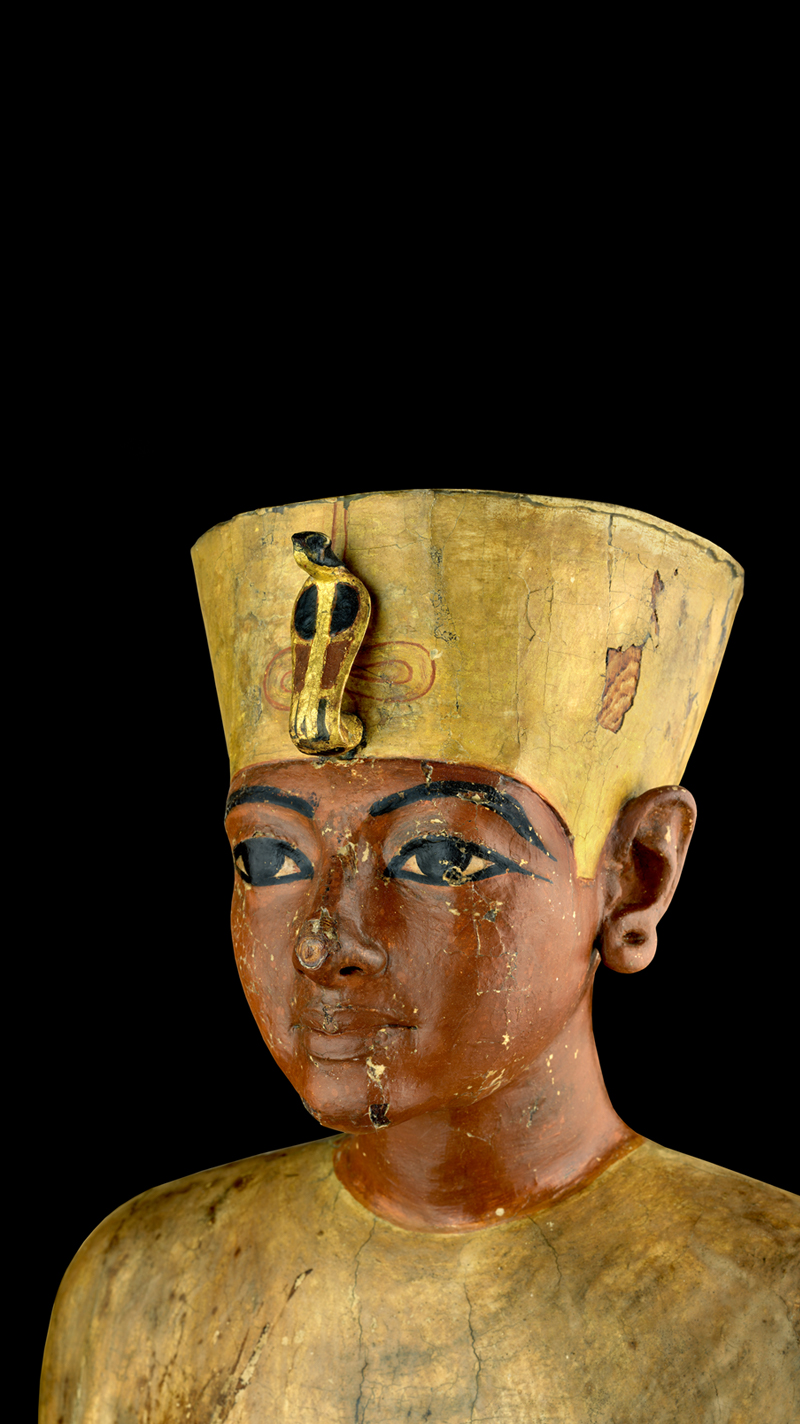
Tutankhamun was only eight or nine years old when he became pharaoh. This life-size wooden statue may capture his actual, youthful appearance.
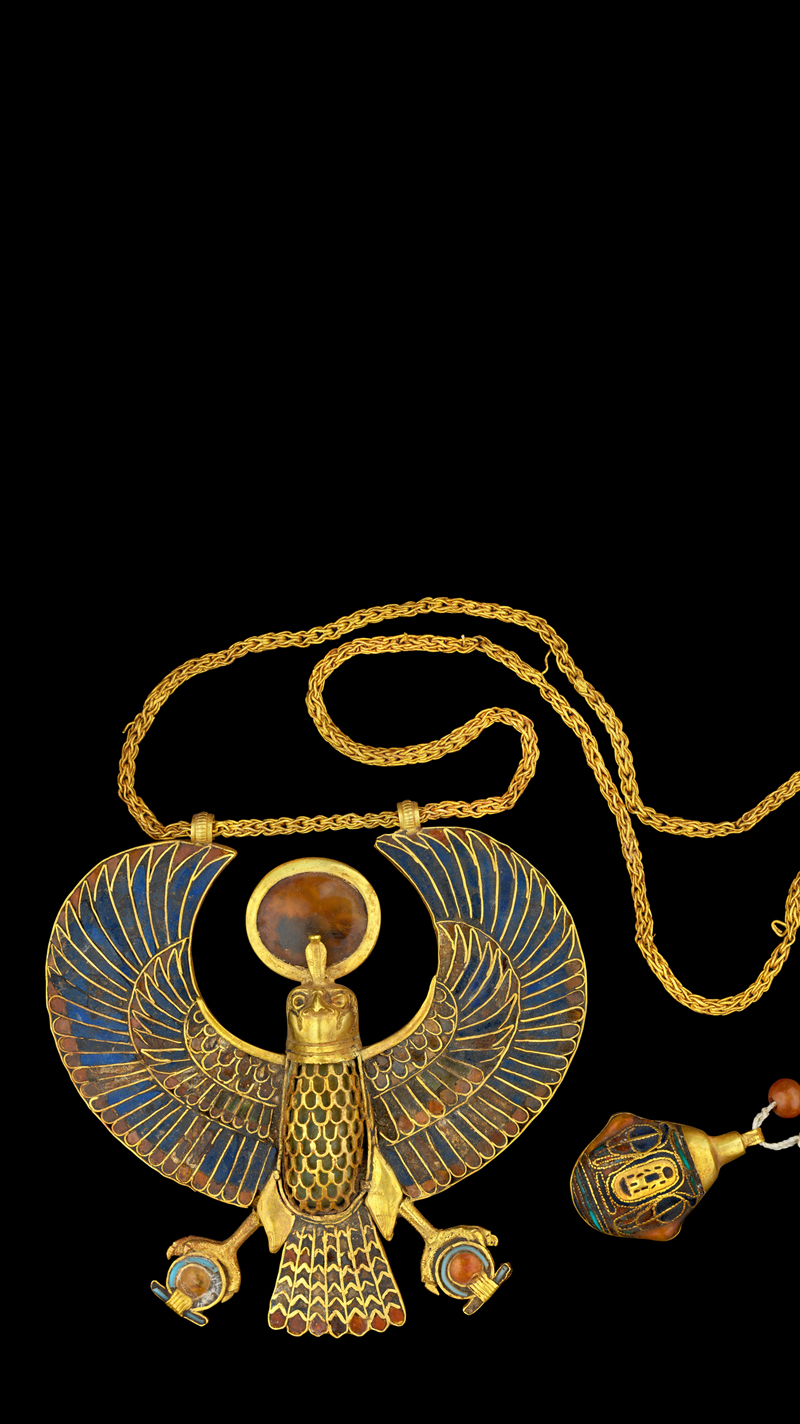
Tutankhamun died unexpectedly in his late teens. Much of the jewelry in his tomb was likely made for his burial, but this exquisite falcon-shaped pendant bears signs of wear and was probably his personal belonging.
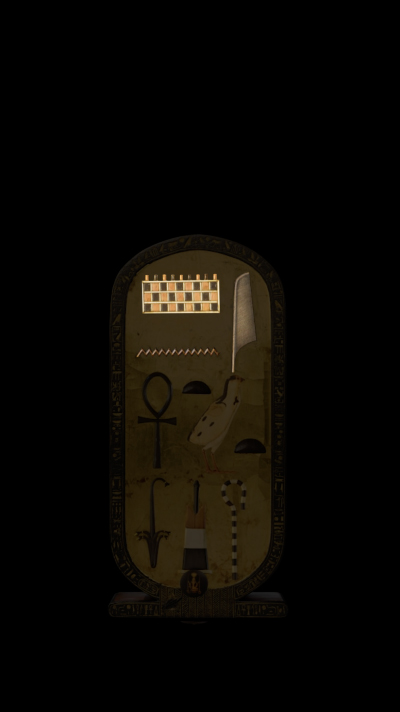
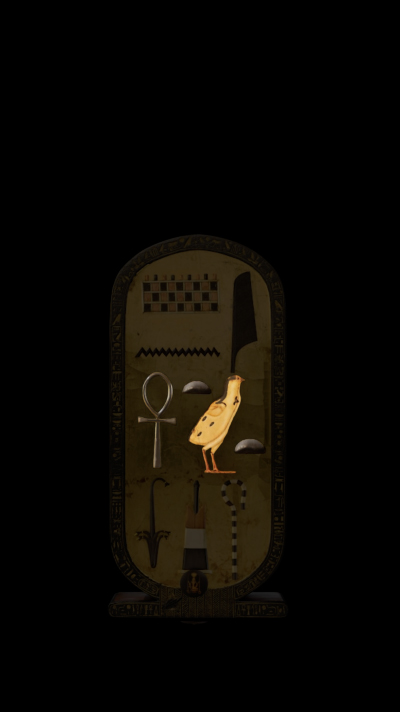
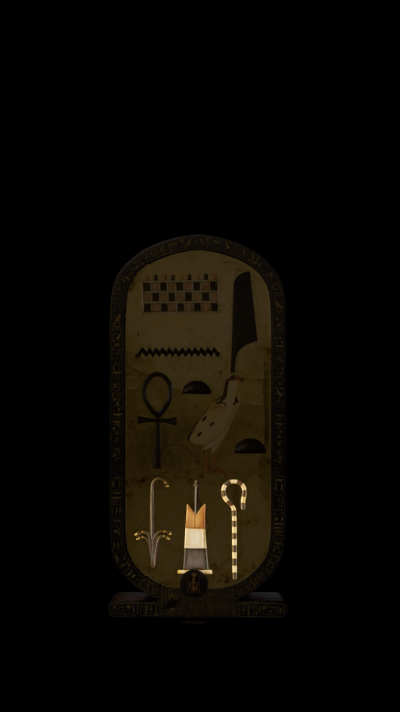
This wooden chest from Tut’s tomb is about two feet long and shaped like a cartouche—an oval containing hieroglyphs symbolizing the pharaoh’s name.
“Tut-ankh-amun” means “living image of Amun,” king of the gods. The top three hieroglyphs spell Amun’s name.
The ankh (at left) symbolizes eternal life. The bird and two loaves spell “tut,” meaning “image,” hence “living image.”
A crook (for “ruler”) plus two symbols for the city of Thebes declares Tutankhamun leader of Amun’s sacred city.
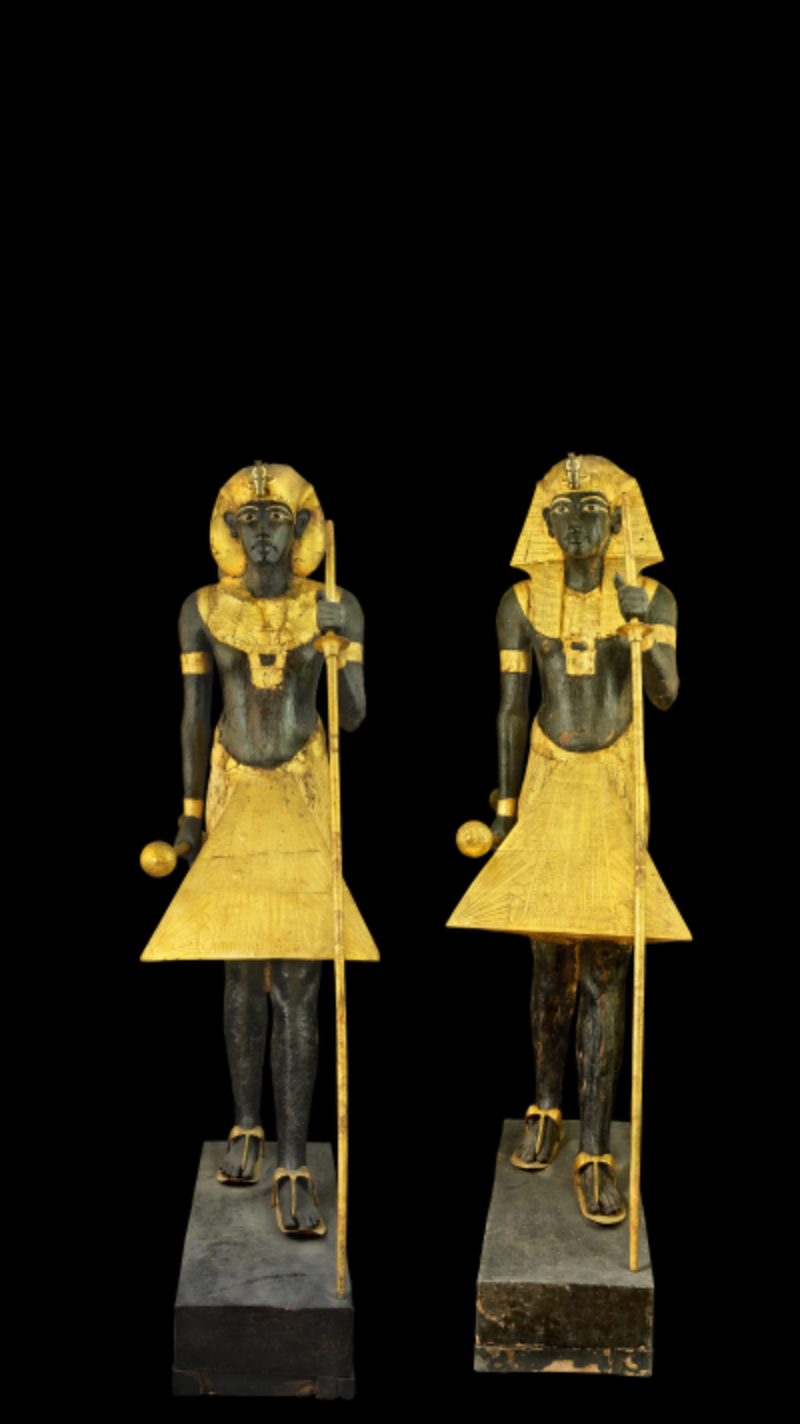
Life-size statues of Tutankhamun guarded his burial chamber and depicted him as Osiris, god of the underworld, the skin painted black as a symbol of death.
Each statue holds a staff and mace and wears a collar, a kilt, and sandals. But notice the different headdresses.
This statue shows King Tut wearing the nemes headdress—the same one seen on his famous burial mask.
The uraeus, or rearing
cobra, was a symbol of
royalty.
Inscription reads
“Tutankhamun,
forever alive like
Ra each day.”
The uraeus, or rearing
cobra, was a symbol
of royalty.
Inscription reads
“Tutankhamun,
forever alive like
Ra each day.”
An inscription identifies this statue as the king’s ka, or spiritual double. It wears the simpler khat headdress, with no pleats or stripes and open in the back.
Inscription reads
“The perfect
god filled with
glory, a king to
be proud of,
the royal ka.”
Inscription reads
“The perfect
god filled with
glory, a king to
be proud of,
the royal ka.”
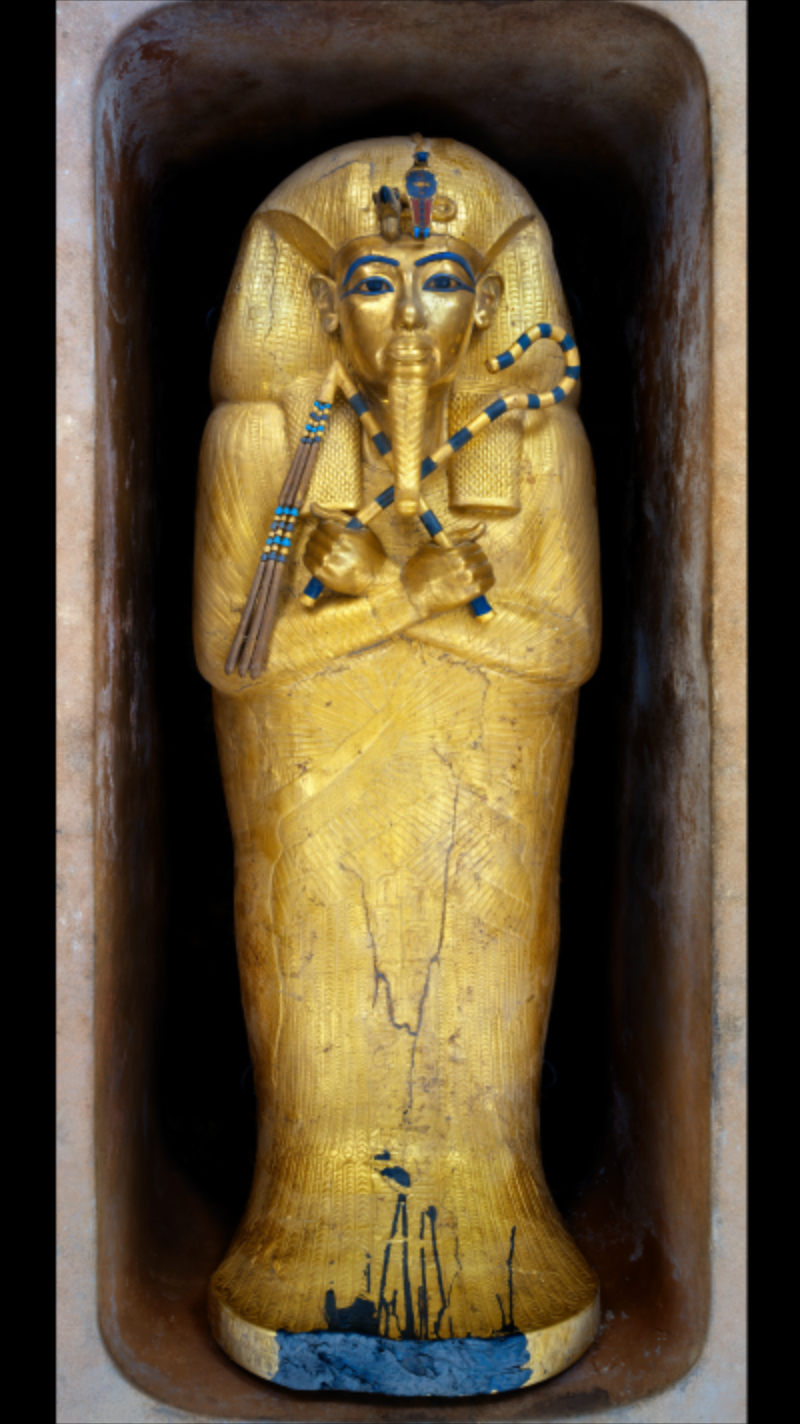
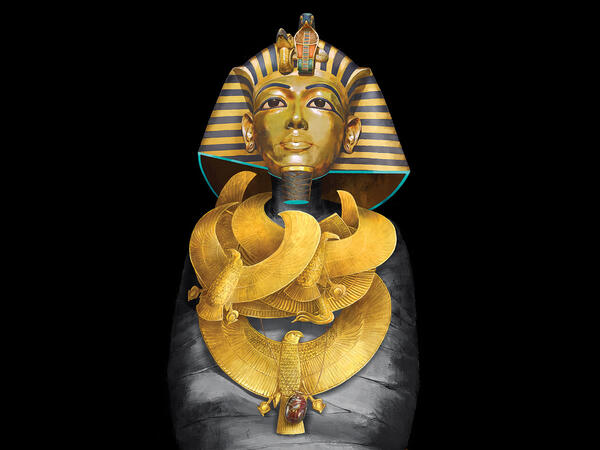
At the heart of King Tutankhamun’s tomb was an immense sarcophagus carved from a single block of quartzite. It contained three mummy-shaped coffins nested one inside the other like Russian dolls.
Tut’s sudden death sent his officials scrambling to gather grave goods. When they discovered that this coffin was too long for the sarcophagus, they hacked off pieces from the bottom.
The innermost coffin, made of about 243 pounds of solid gold, safeguarded the boy pharaoh’s mummy in royal splendor. It was also protected by four goddesses whose images appear on the coffin.
Nekhbet,
vulture
goddess of
Upper Egypt
Wadjet,
snake
goddess of
Lower Egypt
Isis,
goddess of
magic and
sister-wife
of Osiris
Nephthys,
goddess,
protectress of
the dead, and
sister to Osiris
Nekhbet,
the vulture
goddess
of Upper
Egypt
Wadjet,
the snake
goddess
of Lower
Egypt
Isis,
goddess of
magic and
sister-wife
of Osiris
Nephthys,
goddess,
protectress of
the dead, and
sister to Osiris
Each coffin depicts Tut holding a crook and flail, symbols of royal power.
Each also features a curved beard in the likeness of Osiris, god of the dead.
Guardian deities with spread wings wrap the coffins in their protective embrace.
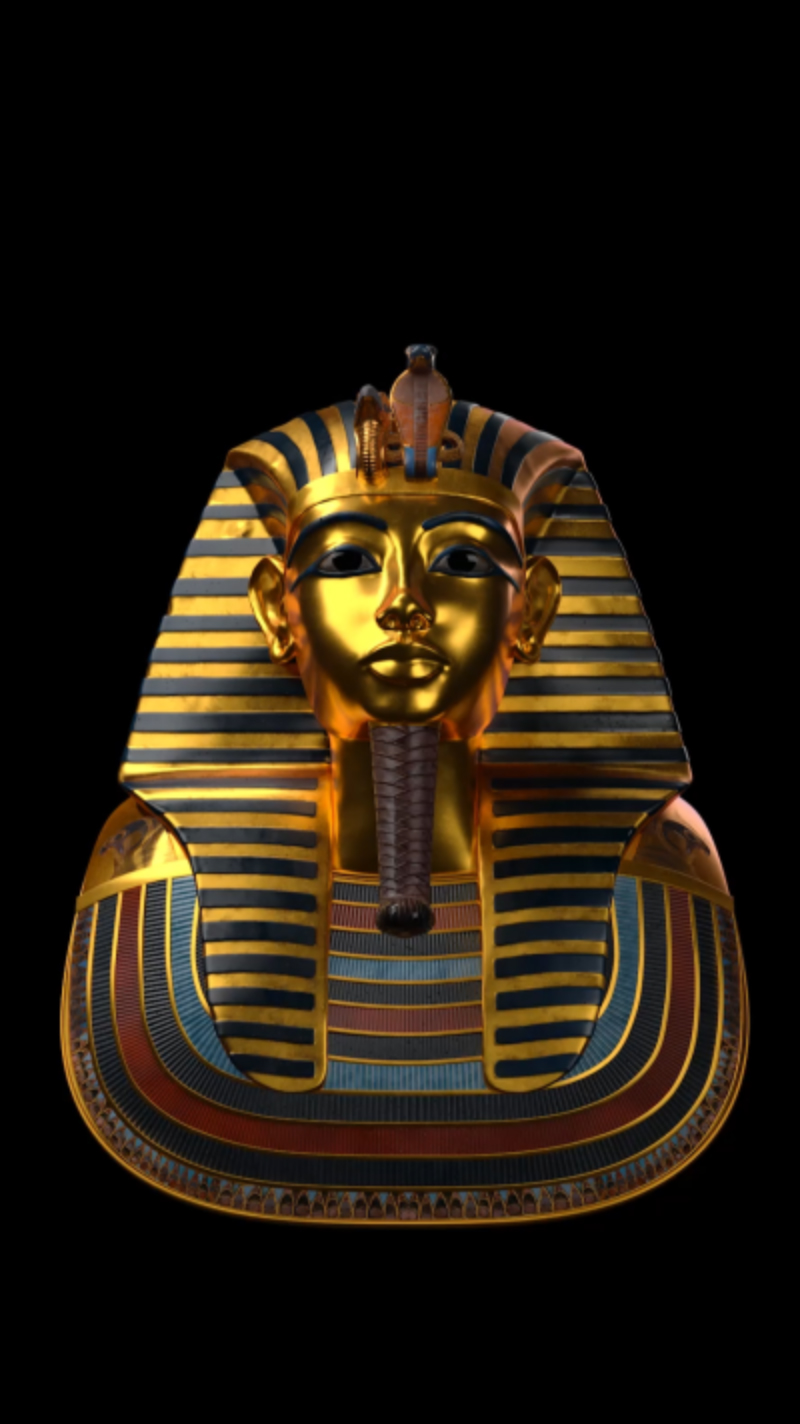
An icon of ancient Egypt, Tut’s resplendent burial mask immortalizes his features in gold, glass, and semiprecious stones.
The back of Tut’s golden mask was inscribed with a magical spell to summon the gods’ protection in the underworld.
The vulture and cobra on the king’s brow represent Nekhbet and Wadjet, guardian goddesses of Upper and Lower Egypt.
A guide to the great beyond, three scenes on the north wall of Tutankhamun’s burial chamber map out his journey to the next world, from right to left.
Scene one depicts the “opening of the mouth” ritual in which Tut’s successor, Ay—wearing a priest’s leopard skin and holding a tool called an adze—symbolically revives the mummified pharaoh, here depicted as Osiris (at left).
In the middle scene, Tut, now dressed as a living king, is welcomed to the realm of the gods by the sky goddess Nut.
The final scene shows Tut, in a striped headdress, and his ka, embracing Osiris, with whom he then becomes one.
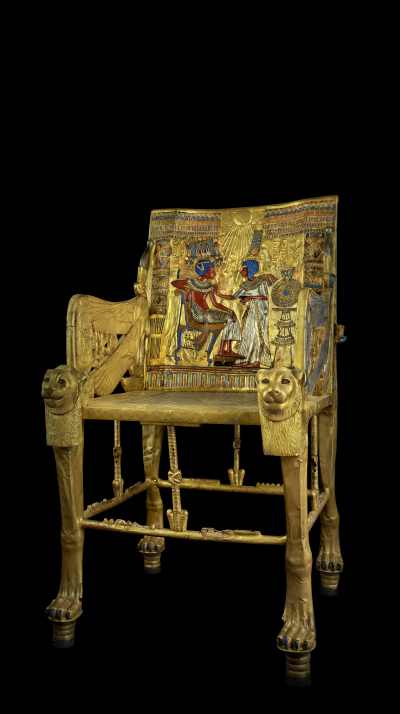
Tut’s golden throne features a tender scene.
His queen, Ankhesenamun, rubs him with perfumed oil.
They bask under the sun disk, Aten. Tut came to the throne after Pharaoh Akhenaten, likely his father, decreed that Aten was the one and only god, causing great turmoil. Tut restored worship of the old gods, particularly Amun.
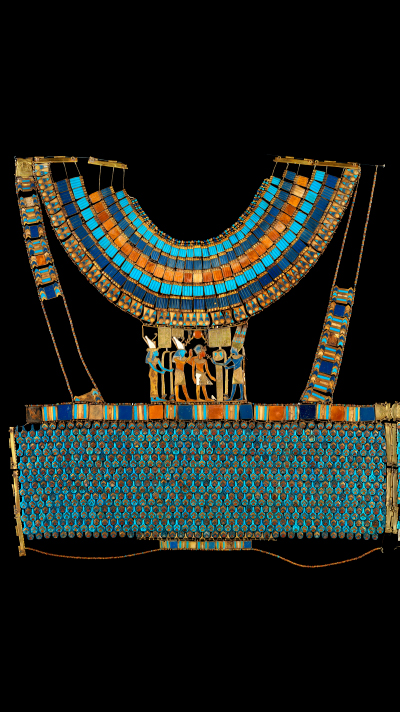
The king’s elaborate corselet, a ceremonial breastplate, shows him before Amun, who offers him an ankh, the symbol of life.
Pieces of the corselet are missing, likely stolen by robbers who ransacked the tomb but took only small, portable items.
This gap in the corselet's
design, along with others
near the neckline, is an area
where pieces are missing.
This gap in the
corselet's design,
along with others
near the neckline,
is an area where
pieces are missing.
High on the back of the corselet, a pendant features a scarab with the wings and tail of a falcon carrying the sun disk aloft. The hybrid creature holds an ankh in each talon, representing eternal life.
The scarab is guarded on each side by a royal cobra, one wearing the conical, white crown of Upper Egypt (at left) and the other bearing the red crown of Lower Egypt, with its projecting curl.
Pieces of the corselet were found in various boxes and strewn across the tomb. (One part was found in a dish of dates.) Curves and thread holes guided the restoration of the ceremonial armor.
Tut was the last heir of a powerful family that had ruled Egypt for centuries and built a far-reaching empire. His burial goods included chariots, bows, arrows, shields, and other weaponry, indicating that he had learned to hunt and fight like other pharaohs.
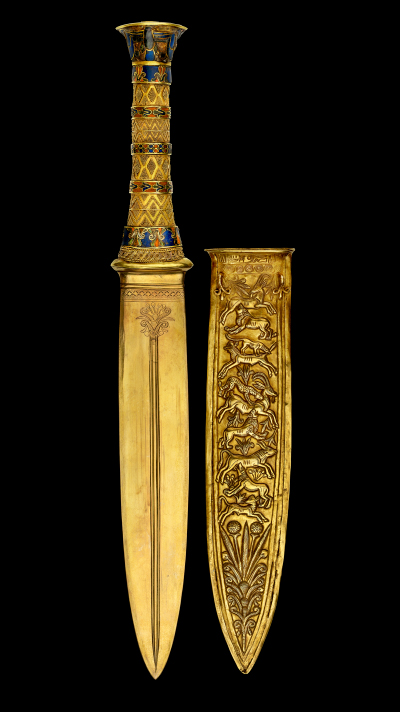
Tut’s mummy wore two daggers to help him fend off foes in the underworld, such as the giant serpent Apep. This dagger has a blade of pure gold.
A hunt scene on the scabbard is non-Egyptian in style. The dagger may have been a gift from a foreign ruler.
A pharaoh would need chariots in the next life for warfare and hunting, and Tut was supplied with no fewer than six. His state chariot was richly decorated and used mainly for parades and ceremonies.
Bound captives adorn the gilded interior of Tut’s state chariot, displaying the king’s victory over Egypt’s foes. Here, a lily stalk is tied around the neck of a Nubian captive, while a papyrus stem binds an Asiatic enemy.
Nubian
Asiatic
Nubian
Asiatic
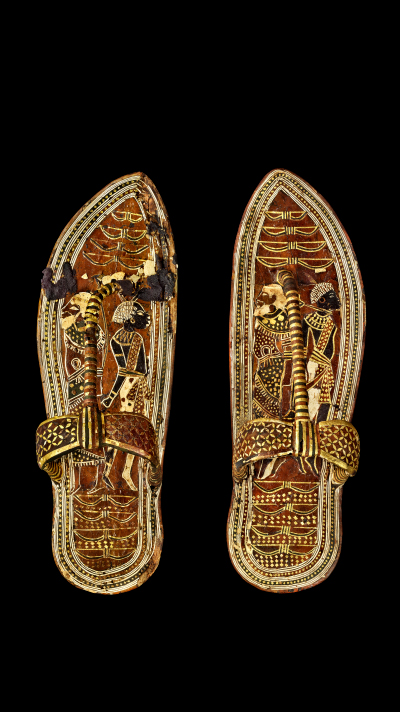
A pair of Tut’s sandals is decorated with war captives, allowing the king to symbolically crush enemies with every step.
Asiatic (at left) and Nubian captives are depicted on the sandals.
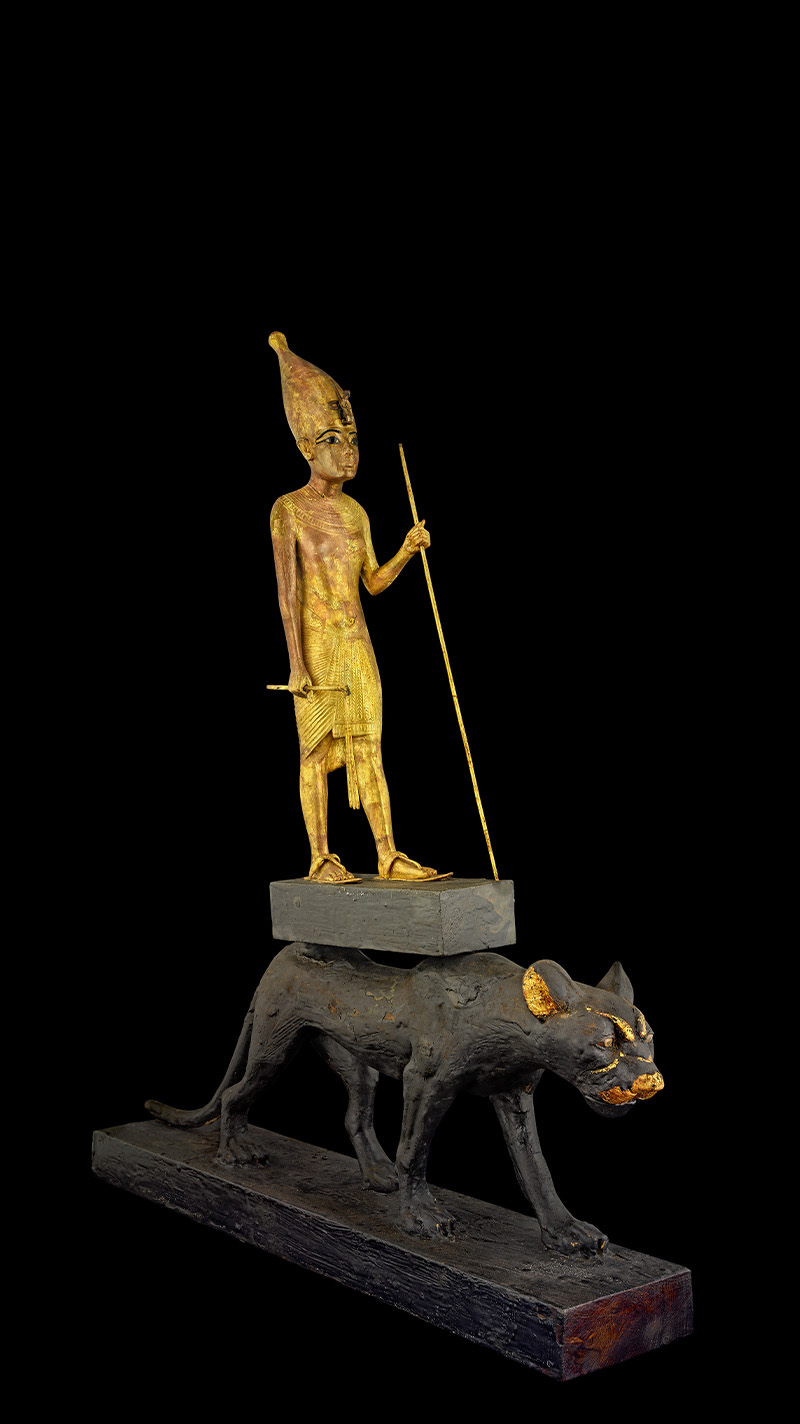
Riding on the back of a black leopard ensures Tut’s safe passage through the dangerous netherworld.
Described as “one of the greatest artistic treasures” from the tomb, this chest celebrates Tut as a fearless hunter and triumphant warrior. This side panel portrays him as a sphinx trampling his adversaries.
Tut turns an enemy army into a confused mass in this battle scene. An inscription declares him to be “a possessor of strength who tramples hundreds of thousands, who makes them into a pile of corpses.”
Tut’s entourage follow their leader toward the fray. Their numbers include a pair of fan bearers running behind the pharaoh’s chariot.
Launching an arrow from his speeding chariot, Tut charges into battle. His enemies fall beneath his horses’ hooves and into the jaws of his war dogs. Above his head, vulture goddesses give divine protection.
Tut’s vanquished foes on this panel were most likely people of the Levant, an area roughly equivalent to modern Syria, Israel, Jordan, and Lebanon.
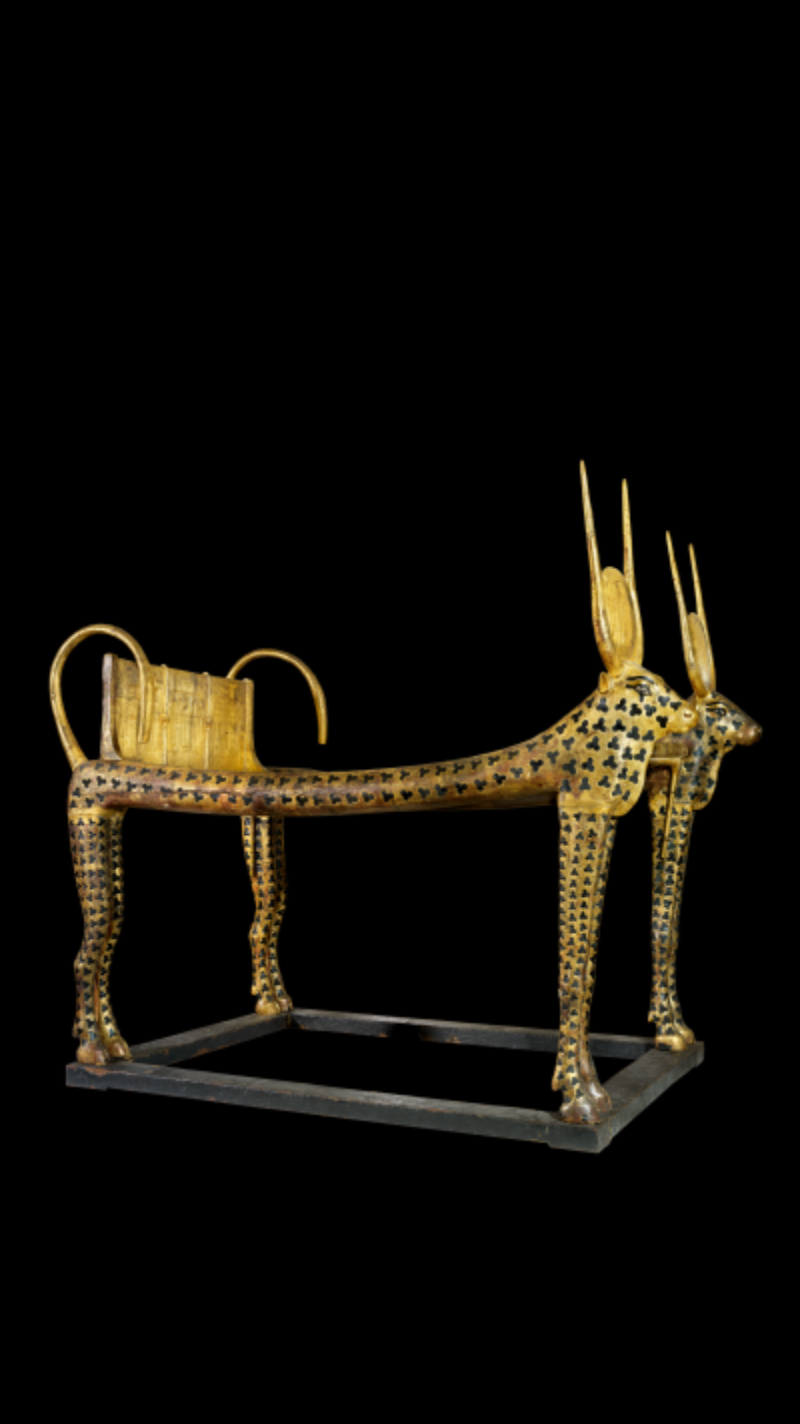
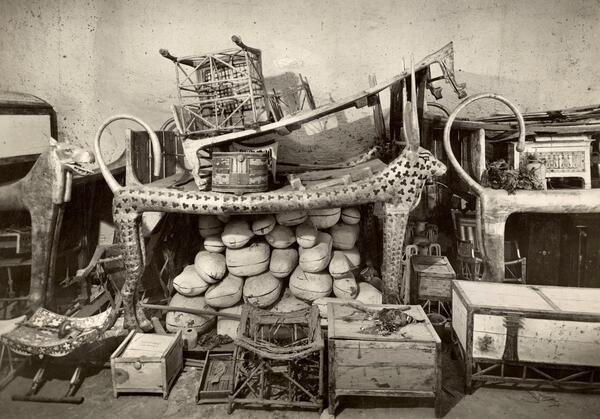
A ceremonial bed—one of three from the antechamber of Tutankhamun’s tomb—embodies the ancient Egyptian myth of Mehet-Weret, a cow goddess who rose from the primordial sea carrying Re, the sun, into the sky.
The gilded funerary bed depicts two sacred cows bearing a sun disk between their horns.
Six other, more practical, beds were placed in the tomb to ensure the king’s eternal rest.
These stories appear in the November 2022 issue of National Geographic magazine.
Photographs: Sandro Vannini/Laboratoriorosso. 3D models: Laboratoriorosso
NGM Staff:
Photo Editor: Todd James
Video Editor: Rebekah Barlas
Design: Nicole Thompson, Elaine Bradley
Development: Eric Blom, Brian T. Jacobs, Ryan Morris, Ben Scott
Text: Glenn Oeland
Copy Edit: Jennifer Vilaga, Cindy Leitner
Research: Taryn Salinas, Brad Scriber