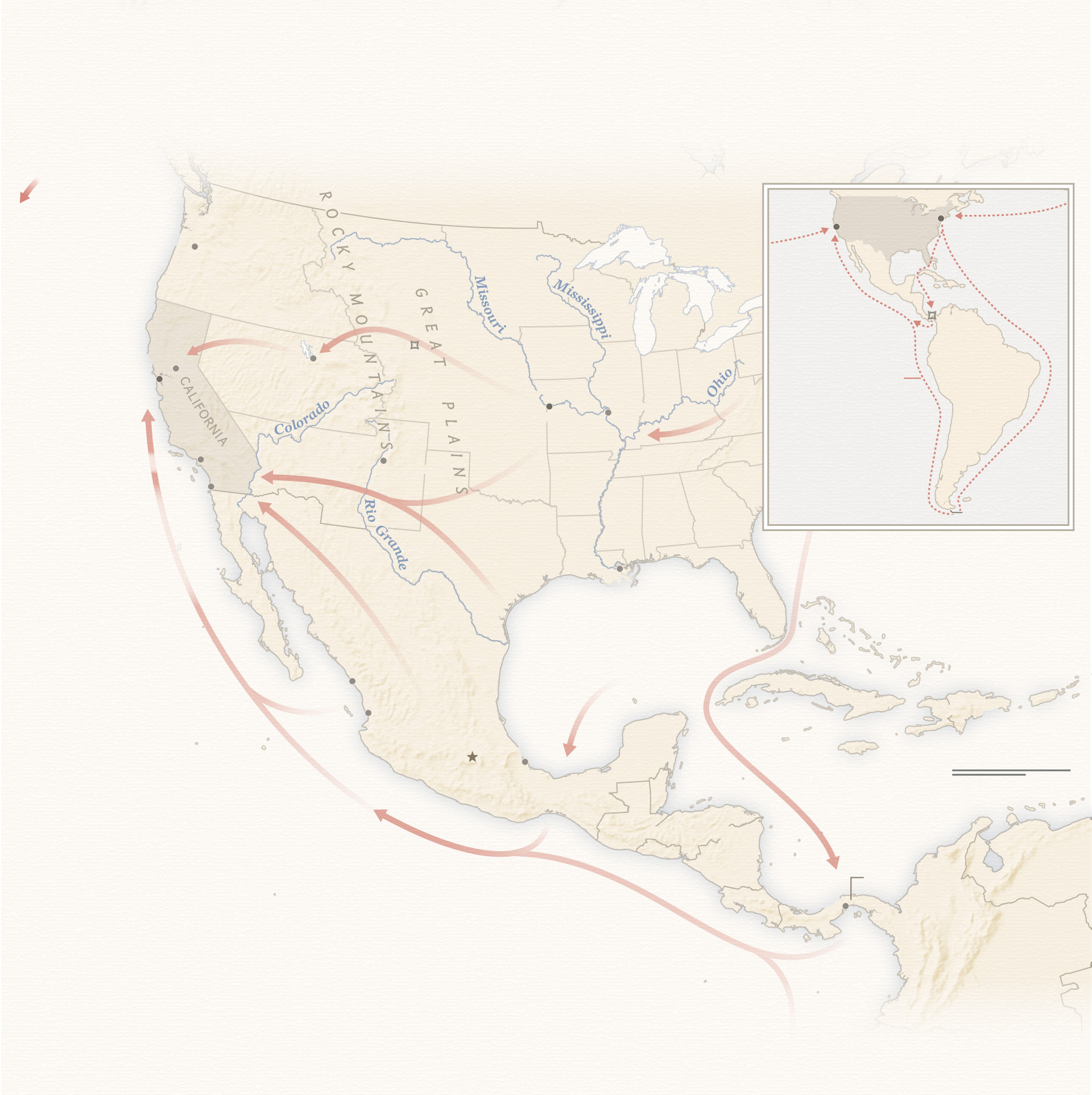
The mass migration that shaped the American West
It’s estimated that 300,000 people migrated to California between 1849 and 1855 from every part of the world, rapidly
setting the economic foundation for the new state. For Indigenous people, terror ensued as armed militias and vigilante miners seized land and resources, murdering those who stood in their way. Exclusionary laws and violence against
foreigners, particularly against Chinese migrants, were also widespread as settlers competed for wealth.
Major
migration route
BRITISH NORTH AMERICA
San
Francisco
U.S.
New
York
From
Europe
Oregon City
NORTH
AMER.
MINNESOTA
TERR.
From
Asia
Unorganized
Territory
OREGON
TERRITORY
ATL.
OCEAN
Isthmus
of Panama
via Panama
5,200 miles
IOWA
Sacramento
Fort
Laramie
SOUTH
AMERICA
Salt Lake City
Main
sailing routes
San
Francisco
UNITED STATES
UTAH TERR.
St. Louis
Independence
PACIFIC
OCEAN
MISSOURI
NEW MEX.
TERRITORY
San
Diego
Los Angeles
Santa
Fe
ARK.
via Cape Horn
13,100 miles
Mexican–American War
California and several other territories were ceded to the U.S. after Mexico’s defeat in 1848.
Cape Horn
TEXAS
LA.
ATLANTIC
OCEAN
New
Orleans
FLA.
Gulf of
Mexico
MEXICO
Mazatlán
Cuba
San Blas
Hispaniola
PACIFIC
OCEAN
Mexico City
Veracruz
400 mi
400 km
Isthmus of
Tehuantepec
Caribbean
Sea
CENTRAL AMERICA
The Panama shortcut
Isthmus of
Panama
Panama
City
Crossing the fifty-mile-wide Isthmus of Panama on foot-trails, and
later by rail, was a shorter alternative to sailing around South America.
The gold rush was a major economic boom for the area—the United States would go on to complete the Panama Canal across the isthmus to seize control of this important trade link between oceans.
SOUTH
AMERICA
COLOMBIA
Boundaries of 1850 are shown
Katie Armstrong, NG Staff. Sources: CA Native American Heritage Commission; San Diego State University Research Foundation; Malcolm J. Rohrbough, Days of Gold; Sandra W. Meditz and Dennis M. Hanratty, Panama: A Country Study

The mass migration
that shaped the
American West
It’s estimated that 300,000 people migrated to California between 1849 and 1855 from every part of the world, rapidly setting the economic foundation for the new state. For Indigenous people, terror ensued as armed militias and vigilante miners seized land and resources, murdering those who stood in their way. Exclusionary laws and violence against
foreigners, particularly against Chinese migrants, were also widespread as settlers competed
for wealth.
San
Francisco
U.S.
New
York
From
Europe
NORTH
AMER.
From
Asia
ATL.
OCEAN
Isthmus
of Panama
via Panama
5,200 mi
SOUTH
AMERICA
Main
sailing routes
PACIFIC
OCEAN
via Cape Horn
13,100 mi
Cape Horn
Major migration route
BRITISH NORTH AMERICA
Oregon
City
Mississippi
River
OREGON
TERRITORY
Unorganized
Territory
MINN.
TERR.
Ft. Laramie
UTAH
TERR.
Salt Lake City
St.
Louis
San Francisco
Independence
MO.
NEW MEX. TERR.
CALIFORNIA
UNITED
STATES
LA.
TEX.
New
Orleans
MEXICO
Gulf of
Mexico
Mazatlán
San Blas
Mexico City
Isthmus of
Tehuantepec
PACIFIC
OCEAN
400 mi
Route around
South America
400 km
The Panama shortcut
Crossing the fifty-mile-wide Isthmus of Panama on foot-trails, and later by rail,
was a shorter alternative to sailing around South America. The gold rush was a major economic boom for the area—the United States would go on to complete the
Panama Canal across the isthmus to seize control of this important trade link
between oceans.
Boundaries of 1850 are shown
Katie Armstrong, NG Staff. Sources: CA Native American Heritage Commission; San Diego State University Research Foundation; Malcolm J. Rohrbough, Days
of Gold; Sandra W. Meditz and Dennis M. Hanratty, Panama: A Country Study